Energy-efficient commercial buildings can create immediate tax savings, but Section 179D is not a simple checkbox. Many building owners, architecture and engineering firms, and construction firms miss significant tax savings because ASHRAE rules, labor documentation, and IRS certification requirements are technical. A 179d tax deduction consultant helps with energy modeling, certification, Form 7205 support, and CPA coordination so eligible projects can capture up to roughly $5 per square foot, indexed for inflation.
Table of Contents
Use these sections to quickly find the 179D tax issue that matters most:
- What Is the 179D Tax Deduction?
- Who Can Benefit from 179D Consulting?
- Which Buildings and Improvements Qualify?
- Current Deduction Amounts and Key Legislative Dates
- How a 179D Tax Deduction Consultant Works with You
- Documentation, Energy Modeling, and Certification
- Common 179D Scenarios
- Why Choose a Specialized 179D Consultant
- FAQ
- Next Steps
What Is the 179D Tax Deduction and Why It Matters Now
Section 179D of the internal revenue code is a federal tax deduction for an energy efficient commercial building or certain residential properties four stories or higher. The 179d tax deduction rewards energy efficiency in commercial buildings and large residential properties; consultants help claim it by overseeing technical, documentation, and tax compliance requirements.
The incentive began under the energy policy act of 2005, was made permanent by the consolidated appropriations act of 2021, and was expanded by the inflation reduction act of 2022. The IRA increased the maximum deduction, expanded eligibility to tax exempt organizations, and created bonus rules tied to meeting prevailing wage and apprenticeship requirements.
Who Can Benefit from 179D Tax Deduction Consulting?
179D can benefit commercial building owners, designers of government owned buildings, real estate funds, REITs, energy service providers, and primary designers of tax exempt buildings. Eligible buildings include buildings owned by government entities, indian tribal governments, alaska native corporations, tax exempt entities, and other tax exempt organizations, plus private qualified building projects with qualifying improvements.
Commercial Building Owners and Tenants
Commercial building owners and long-term lessees may qualify when making energy efficient improvements to offices, retail, hotels, warehouses, manufacturing sites, or existing buildings. A consultant reviews energy efficient upgrades from prior years, identifies missed tax benefits, and coordinates with the CPA to reduce tax liability on the tax return.
Architects, Engineers, and Design-Build Contractors
The Section 179D tax deduction is available to commercial building owners and designers of public buildings, such as architects and engineers, who implement energy-efficient improvements. For government agencies, hospitals, libraries, universities, and schools, tax exempt owners often allocate the 179d deduction to designers. Consultants help engineering firms, air conditioning engineers, construction firms, and designers document installed property, allocation letters, and taxable income impacts.
Real Estate Funds, REITs, and Large Portfolios
Portfolio owners can aggregate 179d tax opportunities across many commercial buildings. A consultant builds a repeatable process to screen square foot data, prioritize energy saving assets, track energy efficiency requirements, and connect operational costs, power costs, cost savings, and tax savings.
Which Buildings and Improvements Qualify for Section 179D?
Eligible projects include new construction, renovations, and energy efficient construction in offices, retail, warehouses, hotels, dormitories, high-rise apartments, and mixed-use properties. Qualifying improvements for the Section 179D tax deduction include enhancements to the building envelope, HVAC systems, and interior lighting solutions, all aimed at reducing energy consumption.
Qualifying Systems: HVAC, Lighting, and Building Envelope
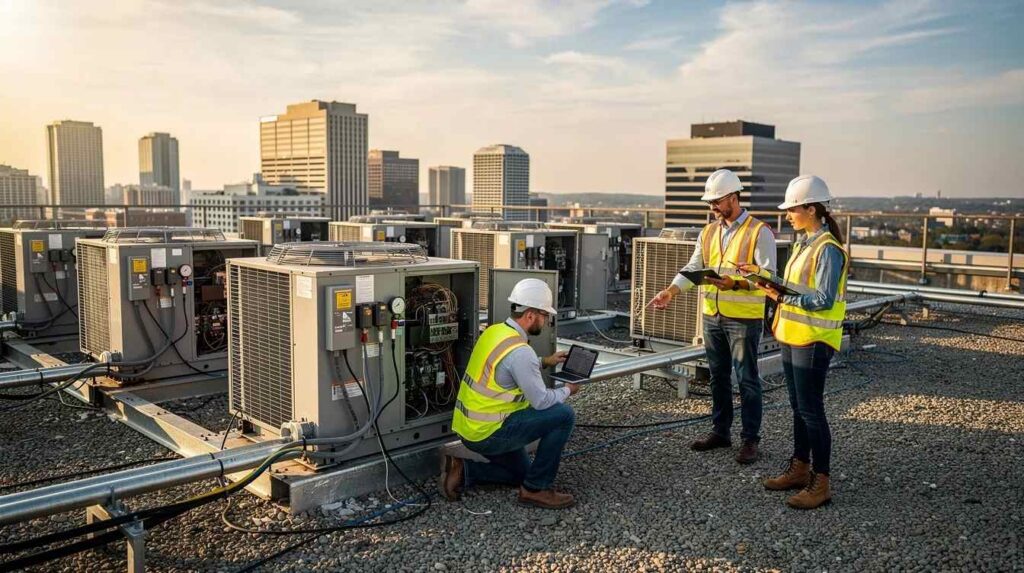
179D covers energy efficient systems such as LED retrofits with controls, VRF systems, high-efficiency boilers, cool roofs, triple-pane glazing, and insulation upgrades. Routine maintenance alone is not enough; building improvements must use energy efficient technologies that reduce energy consumption and support sustainable practices.
Energy Efficiency Requirements and ASHRAE Standards
To qualify for the Section 179D deduction, improvements must achieve a minimum energy savings of 25% compared to a reference building that meets the ASHRAE 90.1-2007 standard. To qualify for the Section 179D deduction, energy-efficient improvements must reduce energy consumption by 25% or more compared to a reference building that meets the ASHRAE 90.1-2007 standard. Later construction projects beginning on or after January 1, 2023, and placed in service on or after January 1, 2027 generally face ASHRAE 90.1-2019.
Current Deduction Amounts, Bonus Rules, and Key Legislative Dates
The deduction value is calculated per square foot on a sliding scale according to the exact percentage of energy savings achieved. The Section 179D tax deduction can provide up to $5 per square foot for qualifying energy-efficient improvements made to commercial buildings, with the maximum deduction amount indexed annually for inflation starting in 2023. The Section 179D tax deduction allows eligible businesses to claim up to $5.00 per square foot for energy-efficient improvements made to commercial buildings placed in service in 2023 and beyond.
For buildings achieving 25% to 50% energy savings without meeting specific union/labor rules, the Base Rate for the deduction is between $0.58 and $1.19 per square foot. Deductions range from roughly $2.50 to $5.00 per square foot if prevailing wage and apprenticeship requirements are met, with the maximum typically capping around $1.00 per square foot without PWA compliance. Each percentage point above 25% raises value until the cap, and prior 179D deductions on the same building can reduce the current maximum deduction.
Impact of the Inflation Reduction Act and Recent Guidance
The Inflation Reduction Act (IRA) of 2022 made significant changes to the Section 179D tax deduction, increasing the maximum deduction to $5 per square foot for energy-efficient improvements made to commercial buildings placed in service in 2023 and beyond. Under the IRA, the Section 179D deduction now applies to buildings owned by tax-exempt organizations, expanding the eligibility for this tax incentive.
Beginning in 2023, the Section 179D deduction allows for an increased maximum deduction if prevailing wages are paid and apprenticeship requirements are met, potentially increasing the deduction amount significantly compared to previous years. The maximum deduction amount for the Section 179D tax deduction can increase significantly if prevailing wage and apprenticeship requirements are met, potentially reaching amounts approximately five times the base savings per square foot.
Sunset and Timing Considerations
Under current federal law, projects that begin construction after June 30, 2026 may lose Section 179D eligibility, so timing is critical. A consultant helps document begin construction dates, safe-harbor milestones, and project phases. Missing just one documentation requirement for labor rates or apprentice hour ratios will trigger a five-fold drop in the deduction value.
How a 179D Tax Deduction Consultant Works with You
A consultant moves from discovery to feasibility, technical study, certification, and CPA support. The role is technical and advisory, not a replacement for your tax advisor.
Step 1: Free Eligibility Review and Data Collection
The review starts with location, use, square footage, placed-in-service date, contracts, and lists of energy efficient improvements. For designers, the consultant reviews tax exempt project lists and identifies public or nonprofit work.
Step 2: Detailed 179D Study and Energy Modeling
To claim the Section 179D deduction, a company must complete a Section 179D study using IRS-approved energy software to model the energy performance of the building and improvements. The IRS does not accept standard utility bills as proof of savings; instead, a consultant utilizes Department of Energy (DOE) approved software to accurately prove and unlock energy reduction percentages.
Step 3: Certification, Allocation Letters, and Tax Filing Support
The Section 179D deduction is claimed using Form 7205 and must be reported in the same tax year when the building is placed in service. A qualified third party, such as a licensed contractor or professional engineer, must sign a certification document for the Section 179D deduction, confirming the energy model and supporting the allocation of the deduction to its respective designer.
Documentation, Energy Modeling, and Compliance Requirements
A strong file includes plans, specs, lighting layouts, mechanical schedules, photos, contracts, payroll records, and signed certifications. Energy modeling must show reduced energy consumption versus the reference building, not just estimated utility savings.
Prevailing Wage, Apprenticeship, and Labor Compliance
The Enhanced Pathway requires contractors to strictly adhere to federal Prevailing Wage and Apprenticeship (PWA) programs during construction. Consultants review payroll, subcontractor agreements, and apprenticeship ratios early because retroactive fixes are difficult.
Common 179D Consulting Scenarios and Case-Style Examples
- 100,000-square-foot office: LED lighting and HVAC upgrades placed in service in 2024 may generate a partial deduction or six-figure result, often $250,000–$500,000 with PWA.
- New school: a tax exempt district allocates 179D to architecture and engineering firms for energy efficient design.
- Warehouse portfolio: roof and envelope upgrades across 200,000+ square foot facilities can create major tax burden reduction and ESG support.
Claiming the Section 179D deduction can provide substantial tax savings, with potential deductions reaching six figures for larger projects, thereby significantly reducing tax liabilities for businesses involved in energy-efficient construction.
Why Choose a Specialized 179D Tax Deduction Consultant
179D sits where the tax code, engineering, and construction meet. A specialist helps optimize designs for tax credits coordination, cost savings, promoting energy efficiency, and a more sustainable future. The best consultants translate complex rules into clear decisions for energy efficient buildings while helping clients protect tax benefits under internal revenue service review.
Frequently Asked Questions about 179D Consulting
FAQ 1: Can I Claim 179D While the Building Is Still Under Construction?
No. The property must be placed in service, meaning ready for use. Modeling can start earlier.
FAQ 2: Will Claiming 179D Trigger an IRS Audit?
No automatic audit occurs, but audit risk exists. Proper certification, software, and documentation reduce exposure.
FAQ 3: Can I Combine 179D with Other Energy Incentives?
Often yes, including rebates or state programs, but double-counting costs can be limited.
FAQ 4: How Far Back Can I Go to Claim Missed 179D Deductions?
Open years and accounting method changes may help. Your consultant and CPA should review the filing path.
FAQ 5: What Does a Typical 179D Study Cost, and Is It Worth It?
Fees vary, but a mid-size project producing six-figure tax savings can easily justify a professional study.
FAQ 6: How Long Does the 179D Process Take?
A single building often takes a few weeks; complex portfolios may take months.
Next Steps: Schedule a 179D Tax Deduction Consultation
If you own, manage, build, or design energy efficient commercial buildings, gather recent project lists, square footage, placed-in-service dates, and scope details. Then request a preliminary 179D review and involve your CPA early. The right consultant can help unlock tax savings from energy efficient upgrades while supporting lower energy consumption, lower operational costs, and a sustainable future.