Whether you just bought a facility, built one, or have owned a few for years, you have probably been depreciating most of the cost over 39 years as if it were all building. On most commercial property the building is the investment and the site is an afterthought. Self-storage puts more of its cost into the site than most property does — drive aisles and paving, perimeter fencing, storm drainage, pole-mounted site lighting, pylon and monument signs — and those improvements recover over 15 years, not 39.
In this article
What It’s Worth
Take a $3 million storage facility placed in service mid-year (land excluded). If a study moves 20% of that cost to 5- and 15-year lives, the first-year deduction goes up by about $593,000 with 100% bonus depreciation — roughly $219,000 less tax this year at a 37% rate, or $142,000 at 24%.
That first-year saving is typically many times what the study costs. The figures are illustrative; your study sets the real number.
A cost segregation study is the engineering exercise that finds those components in your cost and moves them to the shorter lives. What that’s worth depends on when you acquired the facility:
- Bought or built recently — for property acquired and placed in service after 19 January 2025, the 15-year and 5-year components qualify for 100% bonus depreciation and can come off in the first year.
- Owned for years — a study still accelerates the deduction, and the catch-up lands on this year’s return without amending anything; the bonus rate is the one in effect the year the facility was placed in service (more on that below).
What Moves to a Shorter Life
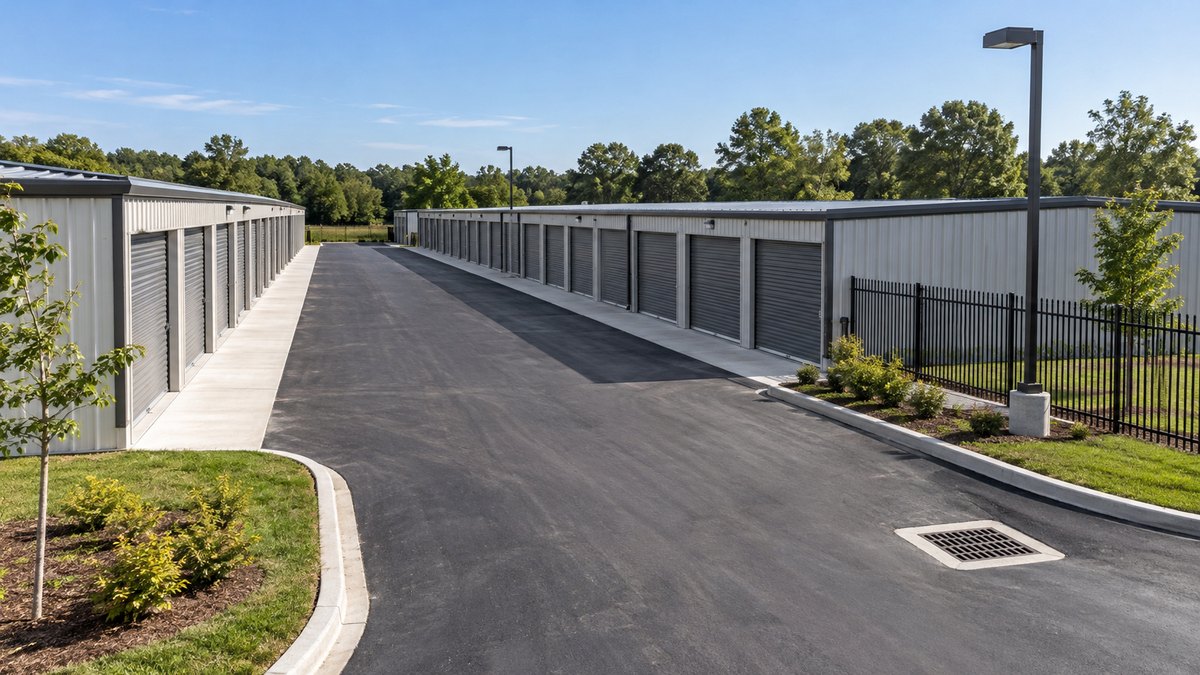
A study sorts the cost of a facility into what the tax rules treat as site work, business equipment and the building itself. On a storage facility, a lot lands in the first two:
- Site work — 15 years. Paving and drive aisles, perimeter fencing, the security gate and its access system, storm drainage, pole lighting and sign structures.
- Business equipment and fixtures — 5 years. Security cameras, recording equipment and monitors, rental-office and retail fixtures and counters, removable floor coverings, sign faces, kiosks and similar equipment.
- The building — 39 years. The structure, roof and the systems that run the building, such as HVAC, plumbing and the general wiring and lighting in the walls and ceilings.
With bonus depreciation, the first two can come off in the first year. Exactly where each component lands depends on how the facility was built and used — that’s the engineering the study does.
Converted or Renovated a Building? Much of the Interior Is 15-Year
A lot of storage today is conversion: an old big-box store or warehouse turned into climate-controlled units. Interior improvements to an existing commercial building — made after it was first placed in service — are qualified improvement property: a 15-year life, eligible for bonus depreciation. In a conversion that typically covers the interior partitions and unit doors, interior lighting and electrical, finishes and the office build-out. Enlargements, elevators, structural framing and exterior work don’t qualify, and it applies to the work you do — not improvements a prior owner made before you bought.
Added Climate Control, a Roof or Security? Section 179
Roofs, HVAC, fire protection, alarm and security systems added to an existing building are qualified real property and can be expensed under Section 179.
For an owner who just added climate control, a new roof or a new security system to an existing facility, Section 179 can expense it in the year it goes in.
Conditions apply — it covers improvements rather than original construction or purchase cost, and there is a taxable income limit — so we check it alongside the study.
The Part of the Site That Isn’t Depreciable
Two things inside “site” don’t depreciate at all, and identifying them up front is what makes the rest of the study hold:
- Raw land, which is never depreciable. On a site-heavy asset in a good market it can be a large share of the purchase price, and the land allocation is the first thing reviewed on a storage acquisition.
- Land preparation — one-time clearing, grubbing, blasting, stripping, fill, dewatering and general grading that wouldn’t be redone if the building were rebuilt. General and perimeter landscaping falls here too. Plantings immediately next to a building that would be destroyed if the building were replaced go on the building’s life.
Which Bonus Rate You Get
Bonus depreciation is back at 100% and permanent for qualifying property acquired and placed in service after 19 January 2025. For a facility you bought, “acquired” generally means when the purchase contract became binding; for one you had built, when significant physical work started. A facility acquired before 20 January 2025 that went into service in 2025 is on the prior phase-down rate of 40% — contract contingencies can move that date, so we check.
For a facility you already own, the rate is the one in effect the year it was placed in service — 100% for property acquired after 27 September 2017 and placed in service by the end of 2022, 80% for 2023, 60% for 2024. Used property acquired before late September 2017 wasn’t bonus-eligible. A look-back on an older facility still produces accelerated depreciation, just not at today’s 100%.
Three Situations Worth a Study
You’ve Owned It for Years and Never Had It Studied
The largest group by far. A study identifies what should have been reclassified from the start, and a change in accounting method captures the cumulative difference on your current return — no amended returns, prior years left as filed. If the facility went into service only last year, the same filing works, or your CPA can amend that one return; a few specific reclassifications fall outside the automatic route, and we’ll tell you which up front.
You Just Bought a Facility
The cleanest case. The study runs off the purchase price allocation and lands in your first year of ownership — at 100% bonus if the acquisition qualifies.
You Built or Expanded
The best source material — construction invoices, draw schedules and site work line items. Accuracy is highest and the land-preparation carve-out is easiest to get right.
What You’d Hand Us, and What We Do
For an acquisition: the closing statement and any appraisal. For a build or expansion: the contractor’s pay applications or draw schedule, and the site plan. For any facility: the year it was placed in service and its square footage. We review the drawings and costs, visit the site, quantify each component against the IRS’s own examiner guidance, and hand you a report your CPA uses to file — including the change-in-method filing for a facility you’ve owned for years.
Three Numbers
What we’ll need: Purchase or construction cost · Year placed in service · Total square footage
We’ll come back with a realistic range, and tell you plainly if a study doesn’t pay on your facility.
Frequently Asked Questions
Will this cause an audit?
It shouldn’t on its own. Cost segregation is an established practice and the IRS publishes its own examiner guide describing how studies should be done. No advisor can promise you won’t be examined; what draws scrutiny is a study built on rules of thumb with no engineering support, or one that reclassifies components the guide treats as building.
What happens when I sell?
Faster depreciation means some of it is taxed back as ordinary income when you sell — on the 5- and 7-year components, all of it up to your gain; on 15-year site work, the part taken faster than straight-line — with the rest taxed like building depreciation, at up to 25%. On a long hold the earlier deduction usually still comes out ahead; on a short hold it may not, so it’s worth modelling against your exit plan.
I own several facilities. Can they go together?
Within the same taxpayer, yes. Most storage portfolios are held one facility per LLC, which generally means one accounting method change filing per entity. Worth structuring deliberately.
Can I use the deduction?
That depends on your own position — passive activity rules and the excess business loss limitation can suspend or cap it. We model that before you commission a study, not after.
What to Do Next
Send the cost, the year placed in service and the square footage. We’ll tell you whether it’s worth doing.
Storage puts more of its cost into site improvements than most property, and site improvements recover faster than buildings — once someone identifies them.
This article is general information about federal tax rules and is not advice for any specific situation. Component classification is fact-dependent and depends on how a particular facility is built and used.
Current as of October 2026.