- How Cost Segregation Consultants Create Tax Savings
- What is Cost Segregation?
- Benefits of Cost Segregation
- Understanding Cost Segregation Consulting
- Cost Segregation Study Options
- Fixed Asset Identification and Classification
- Bonus Depreciation and Tax Savings
- How to Choose the Right Cost Segregation Consultant
- The Cost Segregation Consulting Process
- Common Challenges and Solutions
- Conclusion and Next Steps
- Frequently Asked Questions
How Cost Segregation Consultants Create Tax Savings
Cost segregation consultants are specialized professionals who combine engineering expertise with tax law knowledge to identify accelerated depreciation opportunities within commercial and investment properties. These cost segregation experts analyze building components, land improvements, and personal property to reclassify assets into shorter depreciation schedules, delivering substantial tax savings to property owners. The solutions and support provided by cost segregation consultants are available to all our clients, ensuring a comprehensive and inclusive approach to maximizing tax benefits.
This guide covers the essential criteria for selecting qualified cost segregation professionals, understanding their service methodologies, and establishing productive working relationships that maximize your tax benefits. The scope focuses specifically on the consultant selection process and engagement dynamics rather than the technical mechanics of depreciation calculations. Property owners, real estate investors, and tax professionals evaluating consultant partnerships will find actionable guidance for making informed decisions.
Direct answer: Cost segregation consultants are engineering and tax specialists who perform detailed analysis of building components to identify assets qualifying for 5-, 7-, or 15-year depreciation instead of the standard 27.5 or 39 years. This reclassification typically results in 15-40% of a property’s depreciable basis being moved to shorter-lived asset classes, generating immediate tax savings and improved cash flow in the current tax year.
By the end of this article, you will understand:
- The different types of cost segregation consultants and their qualifications
- Specific criteria for evaluating consultant experience and methodology
- How fee structures and service levels compare across providers
- The step-by-step consulting process from assessment to deliverables
- Strategies for overcoming common challenges in consultant relationships

What is Cost Segregation?
Cost segregation is a powerful tax strategy that enables property owners to accelerate depreciation on specific components of their real estate investments. By breaking down a building into its individual asset classes—such as personal property, land improvements, and structural elements—cost segregation professionals can reclassify these building components into shorter depreciation periods. This approach allows property owners to claim accelerated depreciation deductions, which directly reduce taxable income and generate substantial tax savings.
The primary goal of cost segregation services is to maximize the financial benefits of property ownership. By leveraging this strategy, real estate investors and property owners can improve cash flow, freeing up more capital for reinvestment or business growth. Our team of experienced cost segregation professionals has a proven track record of delivering significant tax savings to clients across a wide range of real estate investments. Whether you own commercial buildings, multifamily properties, or other types of real estate, cost segregation can help you unlock immediate and long-term financial advantages by optimizing your depreciation schedule and minimizing your tax burden.
Benefits of Cost Segregation
The benefits of cost segregation extend far beyond simple tax deferral—they can have a transformative impact on your business’s financial health. By accelerating depreciation deductions, property owners can significantly reduce their tax liability, resulting in more money available to reinvest in their business or expand their real estate portfolio. Improved cash flow is one of the most immediate and tangible benefits, as cost segregation allows you to keep more of your earnings each year. Many investors refer to this advantage as cash flow cost segregation because of its ability to improve liquidity.
Cost segregation also enables property owners to take full advantage of bonus depreciation, which can provide immediate tax savings and enhance your overall tax strategy. By identifying and classifying assets in compliance with IRS regulations, you ensure that you are capturing every available tax deduction while maintaining full compliance. Our cost segregation experts have helped countless real estate investors and property owners achieve substantial tax savings and improved cash flow through our comprehensive cost segregation services. In some situations, identifying eligible incentives alongside depreciation strategies may complement a broader tax credit planning approach. With the right approach, you can maximize the benefits of your real estate investments and strengthen your business’s financial position.
Understanding Cost Segregation Consulting
Cost segregation consulting is the professional service of systematically analyzing real estate investments to reclassify building components for tax purposes. Rather than depreciating an entire property over 27.5 years (residential rental) or 39 years (commercial), qualified engineers and tax professionals identify specific assets that qualify for accelerated depreciation deductions under IRS guidelines.
The consultant’s primary role bridges two distinct disciplines: engineering analysis and tax compliance. On the engineering side, consultants examine structural components, mechanical systems, and construction related costs to determine which elements function as personal property or land improvements. On the tax side, they ensure asset classifications align with IRS regulations and current bonus depreciation provisions, producing audit-ready documentation that supports the depreciation schedule filed on your return. Providing detailed information, such as invoices and cost ledgers, is crucial for maximizing depreciation benefits and ensuring IRS compliance, especially for renovation projects.
Types of Cost Segregation Consultants
Engineering-based firms employ licensed professional engineers and construction specialists who conduct thorough site visits, analyze blueprints, and use industry cost databases like R.S. Means to allocate construction costs. These firms excel at the technical classification work but may require coordination with your CPA for tax return integration.
Tax-focused consultancies are typically led by CPAs or tax attorneys who specialize in depreciation strategies and may subcontract engineering analysis. Their strength lies in seamless tax return integration and understanding how cost segregation fits within broader tax planning strategies, though they may lack the construction expertise for complex classifications.

Hybrid firms combine in-house engineering and tax staff, offering comprehensive cost segregation services that handle both the technical study and tax implementation. These providers can prepare Form 3115 for accounting method changes, coordinate directly with your tax professionals, and defend studies in IRS audits—making them particularly valuable for larger real estate investments.
Consultant Qualifications and Credentials
Professional engineer licenses (PE) or degrees in engineering, architecture, or construction management demonstrate the technical foundation necessary for defensible asset classifications. The IRS explicitly favors cost segregation studies prepared by construction engineers with cost estimating experience, making these credentials essential for audit protection.
Tax credentials including CPA certification and IRS audit experience indicate the consultant can navigate depreciation deductions, bonus depreciation rules, and the complexities of filing Form 3115 for retroactive studies. Consultants with prior IRS examination experience bring valuable perspective on what examiners scrutinize during audits.
Industry certifications from the American Society of Cost Segregation Professionals (ASCSP), particularly the Certified Cost Segregation Professional (CCSP) designation, signal adherence to established quality standards and a code of ethics. While not legally mandated, ASCSP certification provides third-party validation that the consultant meets minimum competency requirements.
Given the technical bridge between engineering and tax law that cost segregation requires, selecting consultants with the right qualifications directly impacts your study’s defensibility and the security of your tax savings.
Cost Segregation Study Options
Every property and investor has unique needs, which is why we offer a variety of cost segregation study options tailored to your goals. Our fully engineered study is the most comprehensive option, involving a detailed analysis of your building’s components by qualified engineers. This approach results in a robust cost segregation report that provides strong support for your tax deductions and stands up to IRS scrutiny.
For clients seeking a faster turnaround, our rapid report offers a streamlined yet thorough analysis of your property’s building components. While less detailed than a fully engineered study, the rapid report still delivers reliable results and valuable tax insights. Our team of cost segregation professionals will work closely with you to determine which study option best aligns with your property, investment strategy, and desired outcomes. No matter which path you choose, you can expect a detailed analysis and expert guidance to help you maximize your tax deductions and achieve your financial objectives.
Fixed Asset Identification and Classification
Accurate fixed asset identification and classification are essential to a successful cost segregation study. Our cost segregation professionals meticulously review your property’s building components, ensuring each asset is correctly categorized into the appropriate asset classes. This process is critical for maximizing your tax deductions and ensuring your depreciation schedule is both accurate and compliant with IRS regulations.
We go beyond simply identifying assets—we also review your existing depreciation schedule, making any necessary adjustments to reflect the latest IRS guidelines and your property’s unique characteristics. By providing a comprehensive and precise cost segregation report, we help you capture every available tax benefit, improve your cash flow, and maintain full compliance. Our commitment is to help you maximize your tax savings while minimizing risk, so you can focus on growing your business and real estate investments.
Bonus Depreciation and Tax Savings
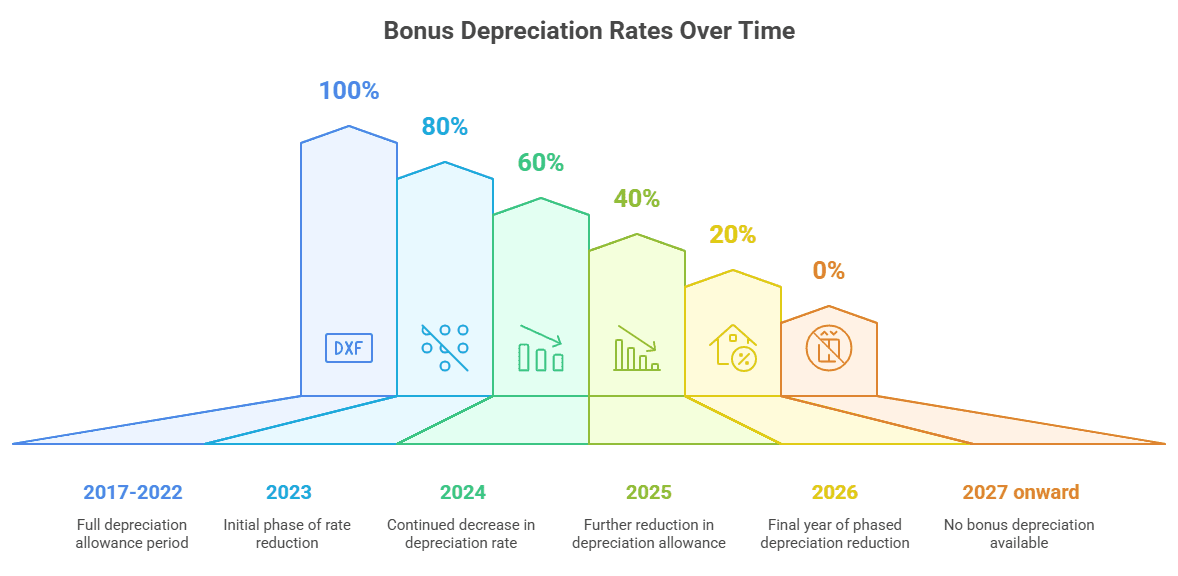
Bonus depreciation is one of the most effective tools for achieving immediate tax savings and enhancing your overall tax strategy. By leveraging bonus depreciation, property owners can accelerate their depreciation deductions, significantly reducing taxable income and increasing cash flow in the year assets are placed in service. This powerful tax incentive can lead to substantial tax savings, especially when combined with a comprehensive cost segregation study.
Our team of cost segregation professionals will assess your eligibility for bonus depreciation and guide you through the complex IRS regulations that govern this tax benefit. We provide a detailed analysis of the potential tax savings you can achieve, ensuring you take full advantage of all available deductions. With our expertise, you can confidently navigate the rules, maximize your tax savings, and improve your cash flow through our cost segregation services. Let us help you unlock the full potential of your real estate investments with strategic tax planning and accelerated depreciation.
How to Choose the Right Cost Segregation Consultant
Selecting the right cost segregation consultant is critical for maximizing tax benefits while maintaining full IRS compliance. The quality of your study directly affects both the immediate tax savings you capture and your exposure to audit challenges.
Experience and Track Record
Look for firms that have performed thousands of cost seg studies across multiple years, as volume indicates refined methodologies and exposure to diverse property scenarios. A proven track record should include specific experience with your property type—hotels, manufacturing facilities, multifamily residential properties, and new construction projects each have distinct component characteristics that experienced consultants recognize immediately.
Verify the consultant’s IRS audit defense history. Reputable firms should readily discuss their audit support success rates and provide references from clients whose studies have been examined. Some firms offer audit assistance at no additional cost, while others charge separately—clarify this before engagement.
Request case studies with quantified results. Strong consultants can demonstrate specific outcomes: reclassification percentages, tax savings figures, and ROI calculations. For example, documented results showing 22% of basis reclassified on multifamily properties or $343,000 in first-year savings on a $4.8 million office building indicate both capability and transparency.
Service Methodology and Technology
Site visit approaches vary significantly among providers. A fully engineered study includes physical inspection (or comprehensive virtual inspection), original blueprint analysis, and component-by-component cost allocation. Desktop studies and rapid reports rely primarily on questionnaires and statistical averages, trading thoroughness for speed and lower cost.
Evaluate how consultants handle blueprint analysis and construction document review processes. Qualified engineers using cost estimating software and local cost indexes produce more defensible allocations than firms applying generic percentages across all properties.
Reporting quality matters for both your CPA and potential IRS examinations. The cost segregation report should include detailed methodology descriptions, component photographs, cost allocation schedules, and clear identification of the preparer’s credentials—all elements specifically mentioned in the IRS Audit Techniques Guide. Comprehensive and well-organized documentation from cost segregation consultants makes the accountant’s job easier when integrating cost segregation results into tax returns.
Cost Structure and Value Proposition
Fee models fall into three categories:
- Fixed fee (flat rates): Predictable cost regardless of savings identified; typical for smaller properties or standardized study types
- Percentage-based: Fee calculated as 15-25% of first-year tax savings or net present value of total savings; creates alignment but potential conflict toward aggressive classification
- Contingency options: Payment only if savings exceed a threshold; shifts risk but may indicate less-established providers
Typical cost ranges depend on property value and complexity. Small residential or multifamily properties may require $5,000-$15,000, while larger commercial buildings typically fall in the $20,000-$35,000 range. Complex manufacturing or hospitality properties can exceed these figures substantially.
Confirm which services are included in the quoted price: audit support, Form 3115 preparation, CPA coordination, and bonus depreciation analysis should all be specified. Timeline commitments matter too—standard turnaround runs 2-4 weeks for engineered studies, though rush service availability (often at premium pricing) may be important for year-end tax planning.
The Cost Segregation Consulting Process
Understanding the consulting process helps you prepare appropriate documentation and set realistic expectations for the engagement timeline and your role as the property owner.
Initial Assessment and Proposal Phase
The process begins with property evaluation and feasibility analysis. Consultants review acquisition documents, purchase price allocation, renovation history, and available blueprints to determine whether a cost segregation study makes economic sense for your situation.
Process steps:
- Property documentation collection: Gather closing statements, construction contracts, architectural drawings, and improvement records
- Preliminary review: Consultant estimates reclassification potential based on property type and available documentation
- Cost-benefit analysis: Projected savings compared against study costs; most properties show ROI payback within 6-18 months
- Proposal presentation: Scope definition including methodology, deliverables, timeline, and fee structure
- Engagement agreement: Formal contract specifying responsibilities, access requirements, and audit support terms
Study Execution Comparison
Different study approaches offer varying tradeoffs between cost, speed, and IRS defensibility:
| Criterion | Rapid Report | Desktop Analysis | Fully Engineered Study |
|---|---|---|---|
| Site Visit Required | No | No | Yes (physical or virtual) |
| Documentation Depth | Questionnaire + minimal docs | Blueprints + cost schedules | Blueprints, invoices, detailed engineering |
| IRS Defensibility | Lower | Moderate | High |
| Timeline | 5-10 days | 1-2 weeks | 2-4+ weeks |
| Cost Range | <$5,000 | $5,000-$15,000 | $20,000-$35,000+ |
For high-value properties where tax benefits are substantial, the fully engineered study typically provides the strongest protection. The higher cost is justified by superior documentation that withstands IRS scrutiny. Rapid reports may suffice for smaller properties or short term rentals where the cost-benefit calculation favors speed over maximum defensibility, but they carry more money at risk if audited.
Common Challenges and Solutions
Even with qualified consultants, several issues commonly arise during cost segregation engagements that can affect study quality and implementation.
Inadequate Property Documentation
Missing blueprints, incomplete construction records, or undocumented improvements can force generic cost allocations that increase audit risk and may understate reclassification opportunities.
Solution: Work with your consultant to reconstruct costs using alternative methods—contractor payment applications, subcontractor invoices, vendor quotes, and industry cost databases can substitute for missing documents. Qualified engineers can apply square footage-based estimates and local cost indexes when original records are unavailable. Document all assumptions clearly in the cost segregation report.

CPA Integration and Coordination Issues
Disagreements between your consultant and CPA regarding useful lives, asset classifications, or Form 3115 filing requirements can delay tax return preparation and create inconsistencies in your depreciation schedule.
Solution: Establish three-way communication protocols at engagement outset. Ensure your consultant provides CPA-friendly deliverables including detailed depreciation schedules with IRS code citations, methodology explanations, and clear guidance on tax return implementation. Clarify in the engagement agreement who handles Form 3115 preparation and which party coordinates the accounting method change.
IRS Audit Concerns and Defensibility
Aggressive classifications, generic templates, or studies lacking proper methodology documentation may be challenged during examination. The IRS specifically scrutinizes studies that apply uniform percentages without property-specific analysis.
Solution: Select consultants offering comprehensive audit support and maintaining detailed methodology documentation aligned with IRS Audit Techniques Guide requirements. Verify that reports identify preparers by name with their credentials and experience, include property photographs, and provide component-level cost allocations rather than unsupported percentages. ASCSP-certified professionals following established standards provide stronger audit protection.
Conclusion and Next Steps
Choosing the right cost segregation consultant determines both the immediate tax savings you capture and your long-term exposure to audit challenges. The investment in a qualified professional who combines engineering expertise with tax law knowledge pays dividends through defensible studies, proper asset classifications, and maximized depreciation deductions.
Immediate actions to take:
- Request proposals from at least three cost segregation professionals with experience in your property type
- Verify credentials including engineering licenses, CPA certifications, and ASCSP membership
- Check references from clients with similar properties, particularly those whose studies have been audited
- Compare fee structures and confirm what’s included (audit support, Form 3115, CPA coordination)
- Establish clear scope expectations and timeline commitments before signing engagement agreements
As you optimize your tax strategy through cost segregation, related topics worth exploring include bonus depreciation planning under current tax law provisions—especially since the Big Beautiful Bill Act, signed on January 19, 2025, reinstates 100% bonus depreciation for qualified property, significantly impacting tax planning strategies for real estate investors—Section 179D energy efficiency deductions for commercial buildings, and ongoing coordination between your cost segregation services provider and tax planning team. These interconnected strategies can compound your tax benefits across your entire real estate portfolio.
Looking for experienced Cost Segregation Consultants to support your tax strategy? Visit the CTA website to learn how our team can help maximize your depreciation benefits. Connect with CTA today to discuss your property, evaluate potential tax savings, and work with knowledgeable Cost Segregation Consultants.
Frequently Asked Questions
What qualifications should I look for in a cost segregation consultant?
Look for engineering credentials (PE license or construction degree), tax expertise (CPA or tax attorney background), and industry certification from ASCSP. The ideal consultant combines structural components knowledge with IRS compliance experience. Verify their audit defense track record and request references from clients with properties similar to yours.
How much does a cost segregation study typically cost?
Study costs vary by property value and complexity. Small residential rental or multifamily properties typically range from $5,000-$15,000, while commercial buildings generally fall between $20,000-$35,000. Complex properties like hotels or manufacturing facilities may exceed these ranges. Most studies achieve payback through tax savings within 6-18 months.
What is the difference between an engineered study and a rapid report?
A fully engineered study involves site visits, blueprint analysis, and detailed component cost allocation by qualified engineers—producing high IRS defensibility. Rapid reports rely on questionnaires and statistical averages without site inspection, completing faster at lower cost but offering less audit protection. Choose based on property value, benefit size, and risk tolerance.
How long does the cost segregation consulting process take?
Rapid reports and desktop analyses can be completed in 5-10 days. Fully engineered studies typically require 2-4 weeks depending on property complexity and documentation availability. Year-end rush services may compress timelines at premium pricing. Plan ahead to incorporate results into your current-year tax return.
Will my cost segregation consultant defend the study in an IRS audit?
Audit support varies by provider—some firms include comprehensive audit assistance at no additional cost. Others charge separately or offer limited support. Confirm audit defense terms in your engagement agreement before proceeding. Look for consultants whose studies follow IRS Audit Techniques Guide standards and include detailed methodology documentation.
Can cost segregation consultants work with properties I purchased years ago?
Yes, retroactive or “lookback” cost segregation studies can be performed on properties acquired in prior years. These require filing Form 3115 to change your accounting method and claim previously uncaptured depreciation deductions. Taxpayers can recover missed deductions without amending prior returns. This a powerful tool for real estate owners who haven’t previously conducted studies on their existing portfolio.