
Your car wash is mostly equipment. Your depreciation schedule probably doesn’t know that.
A tunnel, conveyor, reclaim system, vacuum court and pay stations are not a 39-year building — but that is how most car washes end up on the depreciation schedule. An engineering-based cost segregation study puts those components on the lives they actually belong on, and the deduction can land in a single year.
In-bay automatic
Self-serve & vacuum courts
New builds, acquisitions & remodels
Very little of what you bought is actually “building.”
Office and retail buildings are mostly shell. A car wash is mostly process equipment, site work, and the utilities that feed them — which is why washes tend to reclassify at a far higher percentage than almost any other property type we study.
- Tunnel equipment, conveyor and correlator
- Pumps, blowers, dryers and controls
- Water reclaim, RO and treatment systems
- Vacuum stations and central vacuum plant
- Pay stations, POS, gates and tag readers
- Dedicated electrical and plumbing serving equipment
- Security, cameras and signage electronics
- Paving, curbing, striping and stacking lanes
- Vacuum canopies and equipment canopies
- Site lighting and monument signage
- Drainage, oil/water separators, site utilities
- Fencing, landscaping and irrigation
- Structural frame, roof and exterior walls
- Office, restroom and break areas
- General building HVAC and lighting
- Core plumbing and electrical service
Without a study, all of it — the tunnel, the reclaim system, the vacuum court, the paving — typically sits in one 39-year bucket. A study separates it into supportable classes and documents why, which is what your CPA needs in order to accelerate the deduction.
“I bought my wash four years ago. Did I miss it?”
No. This is the part most owners — and plenty of CPAs — do not realize: a cost segregation study performed today on a wash you placed in service in a prior year does not require amending a single return. The catch-up is claimed on your current-year return through an accounting-method change.
It is a method change, not an error
Depreciating equipment and site work over 39 years for two or more years is treated as an adopted — but impermissible — method of accounting. Correcting it requires the Commissioner’s consent under §446(e), which for this change is granted automatically. That is what Form 3115 does. It is also why the correction cannot simply be made by amending: the procedural rules route it through the method change instead.
The §481(a) adjustment delivers every prior year at once
The adjustment measures the difference between the depreciation you actually took and what would have been allowable had the property been classified correctly from day one — including bonus depreciation at the rate in effect for the year the wash was placed in service. Because you under-depreciated, the adjustment is negative, and a negative §481(a) adjustment is deducted entirely in the year of change. It is not spread over four years; that rule applies to adjustments that increase income.
The bonus rate follows the year you placed it in service
This is the detail that decides how big the catch-up is. A wash placed in service between Sept. 28, 2017 and the end of 2022 generally carries 100% bonus; 2023 is 80%; 2024 is 60%. Under the 2025 law, 100% bonus was made permanent for eligible property acquired and placed in service after Jan. 19, 2025. A 2021 or 2022 acquisition that never got a study is often the single largest catch-up we see.
Filed with the return — no user fee, with audit protection
The Form 3115 goes with your timely filed (including extensions) return for the year of change, with a duplicate copy to the IRS in Ogden. Because the change is automatic, there is no advance IRS approval and no user fee. It also generally carries audit protection for the prior years being corrected — meaning the IRS ordinarily may not raise the same depreciation issue for those closed years. Fixing it does not expose you; leaving it uncorrected is the riskier posture.
What a catch-up can look like
$5,000,000 purchase price; $700,000 allocated to land; $4,300,000 of depreciable basis; placed in service June 2022 (a 100% bonus year); study reclassifies 42% to 5-year and 18% to 15-year property. Figures are illustrative only.
| Component | Basis | Allowable through 2025 under the correct method |
|---|---|---|
| 5-year property — tunnel, pumps, reclaim, vacuums, pay stations | $1,806,000 | $1,806,000 |
| 15-year land improvements — paving, canopies, lighting, drainage | $774,000 | $774,000 |
| 39-year building shell | $1,720,000 | $156,000 |
| Total allowable had it been classified correctly | $4,300,000 | $2,736,000 |
| Less — depreciation actually claimed on a 39-year schedule | ($391,000) | |
| §481(a) catch-up deduction on the current-year return | $2,345,000 |
At a 37% marginal rate that is roughly $868,000 of federal tax — claimed on a return that has not been filed yet, with no amended returns and no reopening of closed years. Whether an individual owner can use a deduction of that size in the current year is a separate question, and it is the one covered next.
Will the loss offset my other income — or sit on the shelf?
A study creates the deduction. The passive activity rules of §469 decide where an individual owner may actually use it. For car washes there is genuinely good news here, and one very specific trap.
An operating car wash is generally not a passive activity by default. Rental real estate is passive per se under §469(c)(2) — which is why rental owners chase Real Estate Professional status. A wash is not a rental: under Reg. §1.469-1T(e)(3) an activity is not a “rental activity” where the average period of customer use is seven days or less and significant personal services are provided. Your customers are on site for minutes. So the wash is an operating trade or business, and the owner only needs to materially participate — no REPS required — for the loss to be nonpassive and available against ordinary income.
The trap: you hired a manager
Material participation is met through one of seven tests in Reg. §1.469-5T. A full-time paid manager quietly eliminates the easy ones:
- “Substantially all” participation is gone the moment a full-time manager exists.
- The 100-hour test (100 hours and not less than anyone else) usually fails — the GM out-hours the owner.
- Management hours may not count at all. Under §1.469-5T(f)(2)(i), time you spend managing is disregarded if anyone else is paid to manage the activity, or if any individual spends more time managing than you. A paid GM can trigger both.
- Investor hours never count (§1.469-5T(f)(2)(ii)) — reviewing financials or monitoring performance from a distance is not participation.
- Limited partners are restricted to three of the seven tests under §1.469-5T(e), which effectively means the 500-hour test.
What actually solves it
Each of these is workable — but each has to be true in fact, and documented before year-end:
- The 500-hour test. The one test that counts all participation and never compares you to anyone else. Operational work — hiring and training, vendor and chemical decisions, equipment calls, site visits, marketing — counts, and is not subject to the paid-manager limitation the way management hours are.
- A spouse’s hours count. Under §1.469-5T(f)(3) a spouse’s participation is attributed to the owner, whether or not they file jointly. This alone resolves a large share of these cases.
- Grouping under Reg. §1.469-4. Multiple washes — or a wash plus your other active businesses — may be treated as a single activity where they form an appropriate economic unit. You then test participation against the combined activity rather than site by site.
- Hold the interest correctly. If active losses are the objective, an LLC or general-partner-type interest preserves all seven tests; a limited partner slot does not.
- Watch the self-rental structure. If the real estate sits in a separate entity leasing to the operating company, net rental income is recharacterized as nonpassive while a net rental loss stays passive — a grouping election is usually the fix.
A genuinely passive owner does not forfeit the deduction. Passive losses suspend and carry forward under §469(b), usable against future passive income — including the wash’s own future profits. On a fully taxable disposition of the activity, §469(g) generally frees the suspended losses, including against ordinary income. And under the 5-of-10-year test, an owner who materially participated in five of the prior ten years keeps nonpassive treatment even after stepping back. The benefit is deferred, not destroyed — but it should be sold and modeled that way from the start, so nobody is surprised at filing.
Material participation is proven with contemporaneous records — calendars, logs, time records kept as the year runs. It is the single most common point of failure on exam, and it cannot be reconstructed convincingly after the fact. If a current-year offset against ordinary income is the goal, start the log the day you decide.
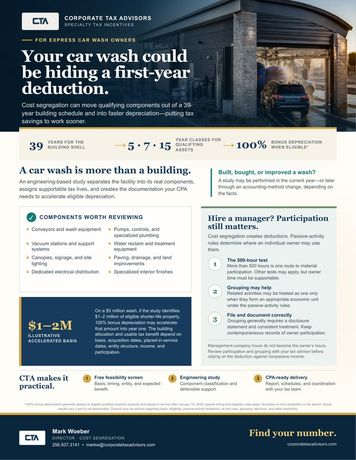
The one-page version, for you or your CPA.
Component checklist, an illustrative accelerated-basis example, the participation questions that decide usability, and how our process runs. Click the page or the button to open the PDF.
Three steps, and the first one is free.
Feasibility screen
We look at basis, acquisition and placed-in-service dates, entity structure, and how you participate — then tell you the realistic benefit and whether a look-back catch-up applies. No cost, no obligation.
Engineering study
Component-level classification of the tunnel, site work, and utilities, with the engineering support and documentation behind every number.
CPA-ready delivery
Report, depreciation schedules, and the §481(a) computation and Form 3115 support your CPA needs — delivered to work with your tax team, not around them.
Find your number.
Send the address, the purchase or construction cost, and the month it opened. That is enough for a first read.
Important. This page is general information for educational purposes. It is not tax advice, does not create a client relationship, and should not be relied upon for any specific transaction. Illustrations are hypothetical, are not a projection or guarantee of results, and assume facts that may not match yours. Land is not depreciable. Actual reclassification percentages, the availability and rate of bonus depreciation, the size and timing of any §481(a) adjustment, and whether losses are passive or nonpassive depend on basis, acquisition and placed-in-service dates, entity structure, income, at-risk limitations, participation, grouping, elections, and state conformity — which varies. *100% bonus depreciation generally applies to eligible qualified property acquired and placed in service after January 19, 2025; special timing and eligibility rules apply, and different rates apply to earlier years. Accounting method changes, grouping elections, and participation positions carry procedural and documentation requirements. Consult your own tax advisor about your specific facts before acting.