Table of Contents
- Why 179D Matters to Architecture Firms Now
- Section 179D Basics for Architects & Design Firms
- How Much Is the 179D Tax Deduction Worth to Architects?
- Who Can Claim 179D: Designer Rules for Architecture Firms
- What Buildings and Improvements Qualify for 179D
- How the 179D Process Works for Architects (Step-by-Step)
- Key Technical Rules Architects Should Understand
- Common Mistakes Architects Make with 179D
- How Corporate Tax Advisors (CTA) Supports Architecture Firms
- Frequently Asked Questions About 179D for Architects
- Why Architects Choose Corporate Tax Advisors for 179D
- Start a 179D Review for Your Architecture Firm
Why 179D Matters to Architecture Firms Now
Many architecture firms are leaving six-figure tax deduction opportunities on the table. If your firm designs energy efficient buildings for government entities, schools, hospitals, or nonprofits, you likely have eligible projects generating zero tax benefit right now.
The Section 179D deduction is a federal tax incentive for energy efficient commercial buildings. It was made permanent in December 2020, then significantly enhanced by the Inflation Reduction Act of 2022. For projects placed in service in 2023 and 2024, qualifying architects can receive over $5.00 per square foot when designing energy efficient buildings for tax exempt entities and government owned buildings.
This article, written from Corporate Tax Advisors’ perspective, covers how the 179D deduction works specifically for architects, what projects qualify, how to claim it, and how CTA’s engineers and tax specialists handle the heavy lifting so your firm captures every dollar available.
Section 179D Basics for Architects & Design Firms
The 179D tax deduction reduces taxable income for energy efficient commercial building property installed in qualifying commercial buildings, including certain residential buildings of four or more stories. Unlike a tax credit, which reduces tax liability dollar-for-dollar, a tax deduction lowers your taxable income on a per square foot basis.
Here is the legislative timeline every architect should know:
- Created by the Energy Policy Act of 2005
- Extended multiple times over the following 15 years
- Made permanent by the Consolidated Appropriations Act on December 28, 2020
- Significantly expanded by the Inflation Reduction Act of 2022, effective January 1, 2023
For tax exempt and government owned buildings, building owners cannot use the deduction themselves. Instead, they can allocate it to the “designer,” often the architect, via a signed allocation letter. Architecture and engineering firms, design-build contractors, and energy service companies can qualify as designers when they create technical specifications for qualifying improvements like HVAC systems, interior lighting systems, and building envelope components. A Section 179D study is required to confirm eligibility and quantify the deduction. Design responsibility is necessary for architects to qualify.
At a glance: Up to $5.36/sq ft for 2023 projects and $5.65/sq ft for 2024 projects, indexed for inflation thereafter.
How Much Is the 179D Tax Deduction Worth to Architects?
Post-IRA rules transformed 179D from a modest benefit into a significant cash flow opportunity for A&E firms. Taxpayers can now receive over $5.00 per square foot for energy efficient improvements that meet full performance and labor requirements.
Here are the current maximum deduction amounts:
| Tax Year | Base (No PWA Bonus) | With Prevailing Wage & Apprenticeship |
|---|---|---|
| 2023 | ~$1.07/sq ft | Up to $5.36/sq ft (maximum deduction increased to $5.81/sq ft with indexing) |
| 2024 | ~$1.13/sq ft | Up to $5.65/sq ft |
| 2025 | ~$1.16/sq ft | Up to $5.81/sq ft |
The deduction uses a sliding scale. Buildings must reduce energy consumption by 25% compared to ASHRAE 90.1-2007 to qualify at the entry level, with each additional percentage point of energy saving increasing the per square foot rate up to the 50% threshold.
The deduction cannot exceed the cost of the installed energy efficient property. Qualifying improvements across HVAC, interior lighting, and building envelope all contribute to overall energy performance.
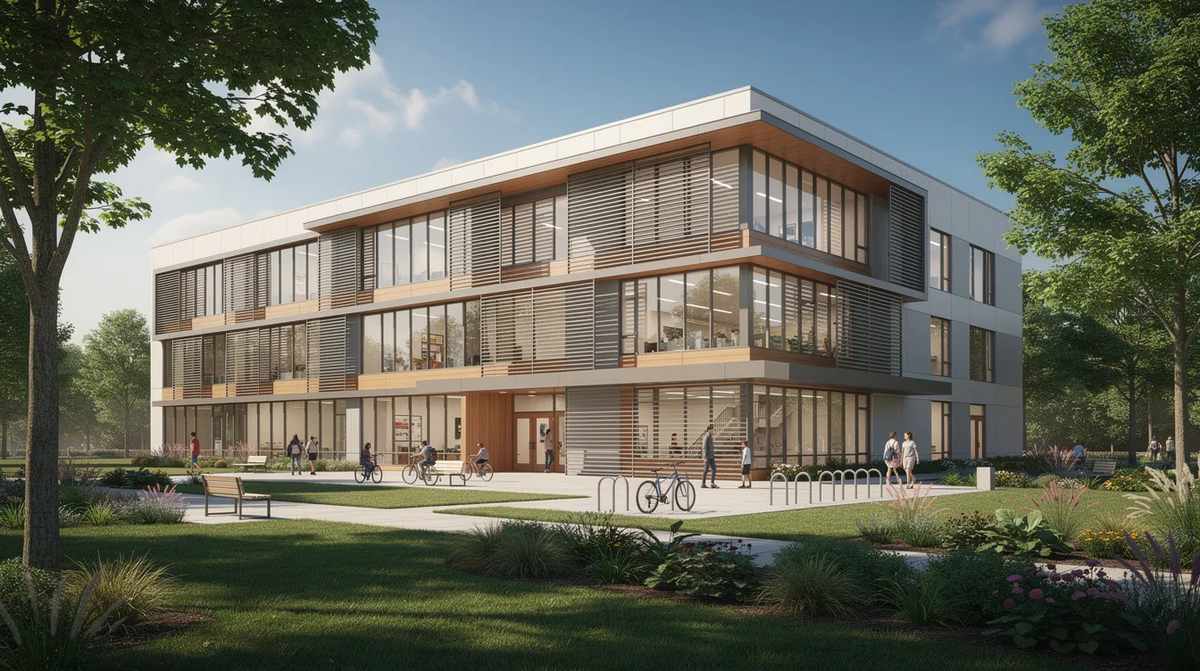
Real-world example: A 120,000 square foot K-12 school placed in service in 2024, achieving 50% energy cost savings and meeting prevailing wage requirements, could generate roughly $678,000 in immediate tax savings for the design firm. Eligible projects can yield up to $250,000 in tax deductions for 50,000 square feet of qualifying space. Architects working on portfolios for a state university system or hospital network can generate recurring 179D deductions year after year. Eligible projects include construction and improvements to commercial buildings over 50,000 square feet.
Who Can Claim 179D: Designer Rules for Architecture Firms
Under IRS guidance, a “designer” is an entity that creates the technical specifications for energy efficient commercial building property. Simply installing or maintaining systems does not qualify.
Most architecture firms leading the design of energy efficient buildings for government entities and tax exempt organizations will qualify if their contract and drawings demonstrate primary responsibility for specifying energy efficient systems. Engineering firms, design-build contractors, and energy service companies may also qualify. Unlike building owners of tax exempt buildings, designers can directly benefit from the section 179d deduction through the allocation process.
Roles that typically do not qualify include:
- Construction managers at-risk without design specifications
- Subcontractors that only install equipment
- Maintenance providers servicing existing systems
For projects owned by a government entity, public university, or nonprofit, the tax exempt owner must sign an allocation letter assigning the 179D deduction to the architect. Claiming the deduction requires an allocation letter from the client. Architects can claim deductions for energy efficient improvements to government buildings, and eligible buildings include government and tax exempt organizations’ properties. CTA helps architecture firms document their role as primary designer using contracts, drawings, and narratives to support the position in case of IRS review.
What Buildings and Improvements Qualify for 179D
Section 179D applies to energy efficient commercial buildings located in the United States, including both new construction and retrofits. The focus is on energy performance versus ASHRAE energy efficiency standards for a reference building.
Typical qualifying building types architects work on:
- K-12 schools and university facilities
- Courthouses, municipal buildings, and libraries
- Public safety buildings and airports
- Hospitals, clinics, and convention centers
- Nonprofit office or community centers
Tax exempt buildings include schools, hospitals, and non-profits. Commercial building owners of private buildings claim the deduction directly, while specified tax exempt entities and government bodies allocate it to designers.
Qualifying improvements must enhance one or more of these areas to reduce energy consumption:
- HVAC and mechanical systems (building envelope heating, cooling, ventilation, hot water)
- Interior lighting and interior lighting systems (controls, fixtures, daylighting)
- Building envelope (walls, windows, roofs, insulation, doors)
Buildings must reduce energy consumption by 25% or more relative to the ASHRAE baseline. Energy efficient designs must meet specific energy reduction requirements based on a reference baseline. For most current projects, ASHRAE 90.1-2007 applies. For projects beginning construction on or after January 1, 2023 and placed in service on or after January 1, 2027, ASHRAE 90.1-2019 will apply. Eligible systems include HVAC, lighting, and building envelope improvements.
How the 179D Process Works for Architects (Step-by-Step)
Here is the practical roadmap from completed project to filed deduction:
Step 1 – Identify candidate projects. Review recent and upcoming construction projects for government entities, tax exempt organizations, and buildings owned by nonprofits where your firm was the primary designer. Focus on buildings placed in service after 2006, especially 2023 forward for higher rates.
Step 2 – Confirm eligibility and designer status. CTA reviews contracts, proposals, and drawings to verify your firm meets the IRS designer definition and that no other designer has already claimed the allocation for that qualified building.
Step 3 – Perform energy modeling. A qualified third party professional engineer uses IRS approved energy software to compare the as-designed building against the applicable ASHRAE 90.1 reference building, determining whether it achieves at least 25% cost savings. A Section 179D study is required for eligibility at this stage.
Step 4 – Site visit and certification. An independent third party, typically a licensed professional engineer, conducts a physical site inspection, validates installed systems, and issues a formal 179D certification report. Third-party certification of energy savings is required to claim the deduction, and a professional engineer must certify the energy efficiency.
Step 5 – Secure the allocation letter. For tax exempt buildings, the building owner signs an allocation letter assigning the section 179d deduction to the architect. CTA provides owner-friendly templates and assists in the process. An allocation letter from the tax-exempt owner is needed for architects to claim the deduction.
Step 6 – Coordinate tax filing. The architect’s CPA reports the deduction on the firm’s return. The deduction can be claimed using Form 7205 for 2023 and later tax years, supported by the certification report and allocation letter.

Key Technical Rules Architects Should Understand
Architects do not need to become tax experts, but understanding a few rules helps avoid missed opportunities.
- Energy savings threshold: Projects must achieve at least 25% reduction in total annual energy and power costs relative to the ASHRAE baseline. Higher savings yield higher deductions per square foot.
- Prevailing wage and apprenticeship bonus: The deduction amount can be influenced by meeting prevailing wage and apprenticeship requirements. Satisfying these power cost requirements can increase the maximum deduction up to roughly five times the base amount, pushing it into the $5+ range. This is how firms utilize energy efficient systems to reach peak benefit.
- Lifetime and frequency limits: For property placed in service after December 31, 2022, the same building can generate 179D deductions approximately every 3–4 years depending on ownership status, but repeated incentives over a facility’s life are still possible under a qualified retrofit plan.
- Placed in service timing: A building must be placed in service (ready and available for its intended use) before the deduction can be claimed for that same tax year.
- June 30, 2026 deadline: The big beautiful bill act added a termination provision. Section 179D shall not apply to property where construction begins after June 30, 2026. Firms must begin construction on eligible projects before that date.
CTA stays current with IRS notices, so called practice units, and announcements so architects do not have to track every technical change themselves.
Common Mistakes Architects Make with 179D
Most firms miss 179D benefits not because projects fail to qualify, but because of process gaps.
- Assuming only building owners benefit. For tax exempt organizations and government entities, the owner cannot use the deduction. Many architects never request an allocation letter and lose the opportunity entirely. Unlike building owners of these properties, designers can directly claim the value.
- Waiting too long. Firms sometimes look at 179D years after the fact, when the window to amend returns has closed. This results in permanent loss of significant tax savings.
- Incomplete energy modeling. Cheap, non-compliant approaches or skipping site visits are red flags in an IRS review. Only work with a qualified third party using IRS approved energy software to avoid invalidation.
- Not coordinating with the CPA. Failure to share certification reports, allocation letters, and workpapers with the tax preparer leads to errors or underutilization. Tax advice from a specialist matters here.
- Confusing 179D with other incentives. The 179d deduction is not a tax credit. It differs from clean energy ITC, cost segregation, and R&D tax credits. CTA coordinates all incentives to avoid double-counting and ensure proper treatment, helping firms contribute to a more sustainable future while maximizing financial return.
How Corporate Tax Advisors (CTA) Supports Architecture Firms
Corporate Tax Advisors is a specialty tax consulting firm focused on complex incentives including 179D, R&D tax credits, cost segregation, and clean energy incentives. CTA works alongside your existing CPA, not as a replacement.
CTA’s engagement model for architects:
- Free initial scoping call to review your project list for 179D opportunities
- Contingency-based fees with no upfront cost; CTA is compensated only when tax savings are identified
- In-house professional engineers and energy modeling specialists who perform 179D studies, conduct site visits, and prepare IRS-ready documentation
- Customized allocation letter templates for government entities and tax exempt organizations
- Multi-incentive coordination including R&D tax credits for design innovation and other federal and state tax incentives
The result is improved cash flow, reduced tax liability, and a stronger business case for energy efficient design across every project in your portfolio. This creates a valuable incentive for firms designing energy efficient technologies and building improvements that drive a sustainable future and meaningful cost savings.
Frequently Asked Questions About 179D for Architects
Can my architecture firm benefit from 179D if the building owner is a nonprofit or government agency? Yes. Tax exempt organizations and government entities cannot use the section 179d deduction directly, but they can issue an allocation letter to the primary designer. In most cases, that designer is the architect. This is one of the most common ways architecture firms capture significant tax savings on public and nonprofit projects.
What documentation does my firm need to claim the 179D tax deduction? You will need a 179D certification report from a professional engineer, energy modeling files generated with IRS approved energy software, site visit notes, the signed allocation letter from the owner, and your design contracts. CTA compiles all IRS-ready support so nothing is missed.
How far back can we go to claim missed 179D deductions? The deduction can be retroactively claimed for three open tax years via amended returns. For older projects, owners may use accounting method changes. CTA reviews prior-year projects to identify opportunities before deadlines expire.
Will claiming 179D increase our risk of an IRS audit? 179D does not automatically trigger an exam. The IRS maintains so called practice units on 179D, but compliant energy modeling, licensed engineer certification, and complete documentation minimize risk. Construction entities and construction contractor firms with proper support have little to worry about.
Does 179D apply only to new construction, or can renovations qualify? Both new construction and qualifying renovations or retrofits of existing energy efficient buildings can qualify as long as they meet the 25% energy performance threshold and other requirements. A qualified retrofit plan must be prepared by a licensed professional to reduce energy use intensity and meets relevant energy standards.
How does 179D interact with other incentives like R&D credits or clean energy ITCs? Multiple incentives can often be layered when they apply to different cost pools. CTA coordinates with your CPA to ensure the 179D deduction, R&D tax credits, and investment tax credit claims do not double-benefit the same expenditures, maximizing overall tax savings.
Why Architects Choose Corporate Tax Advisors for 179D
Architects are busy delivering projects and rarely have internal tax engineering teams. That is exactly why a specialized partner matters. CTA brings over a decade of experience (since 2014) in specialty tax incentives, with deep focus on energy efficient buildings and engineering-driven technical work.
CTA works collaboratively with your existing CPA rather than replacing them. The contingency-based fee model means no upfront cost. CTA’s team includes licensed professional engineers, energy modelers, and tax professionals who understand architecture and engineering firm business models and common contract structures like design-bid-build, design-build, and CM at risk.
Beyond 179D, CTA evaluates R&D tax credits, cost segregation, and clean energy incentives to maximize your firm’s overall tax position across all construction projects and energy efficient upgrades.

Start a 179D Review for Your Architecture Firm
If your firm designs for government, public university, hospital, or nonprofit clients, you almost certainly have eligible projects waiting to be claimed. Gather a list of government and tax exempt projects placed in service since at least 2020 for an initial screening.
Contact Corporate Tax Advisors to schedule a no-cost 179D assessment. CTA will review your project portfolio, estimate potential per square foot deductions, handle the energy modeling and certification, and coordinate with your CPA for seamless filing.
By taking action now, you can convert past and current energy efficient designs into substantial tax savings, reduce energy consumption across your project portfolio, strengthen your sustainability value proposition, and free up cash to invest in talent, technology, and future projects. With the June 30, 2026 construction start deadline approaching, the time to act is now.